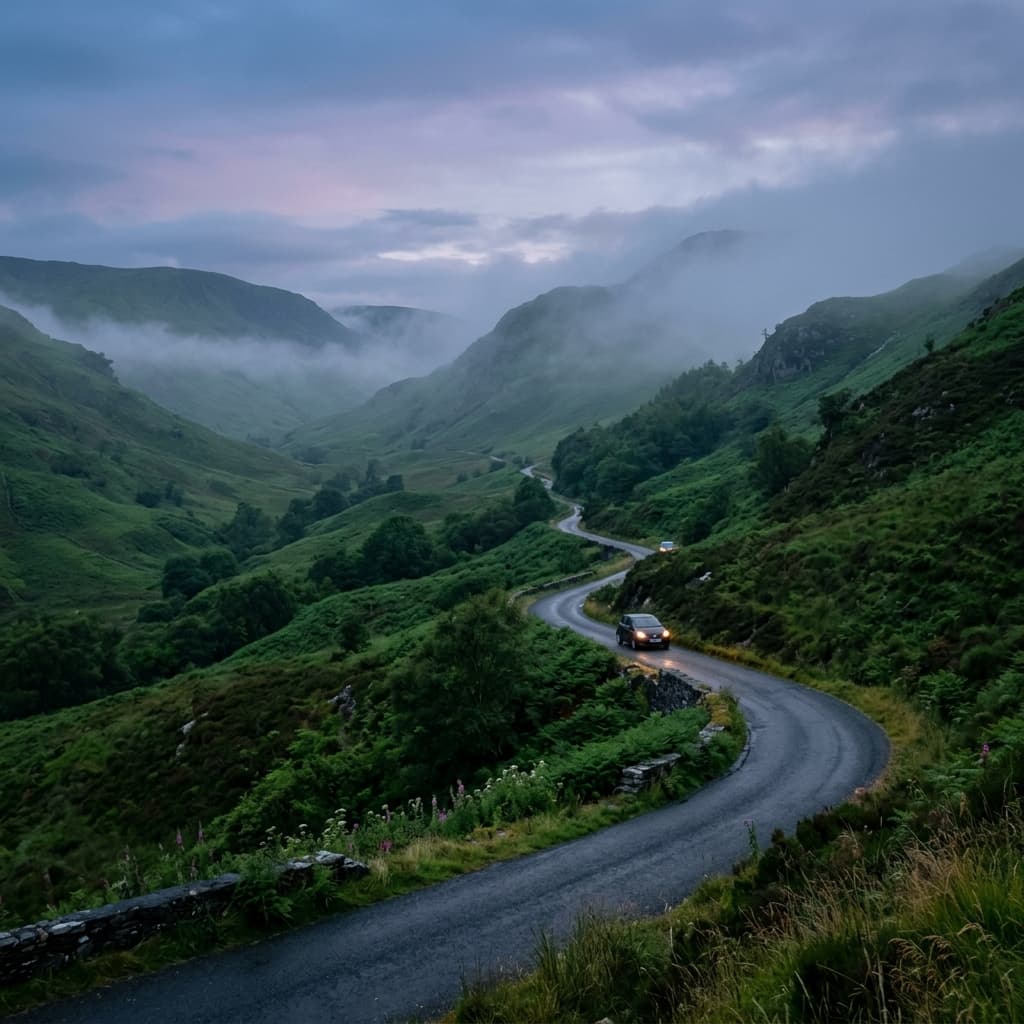
Why detours often become the real destination.
I didn’t mean to take the long way back.
The plan was simple in the way most plans are when they haven’t yet met the day. Leave early. Take the highway. Reach home before the light begins to fade into that soft, uncertain blue. It was meant to be one of those quiet returns—no story, no detour, nothing worth writing about.
But somewhere along the way, something shifted.
It wasn’t dramatic. No missed exit, no sudden breakdown. Just a turn I don’t remember deciding on. A smaller road. Then a narrower one. The kind that feels less like a route and more like a suggestion. The kind that doesn’t promise anything except distance.
At first, I followed it out of curiosity. Then out of stubbornness. And eventually, because turning back felt more complicated than continuing forward.
The map on my phone tried to keep up. It recalculated once, then again, then stopped trying altogether. The signal flickered, hesitated, and disappeared. I was left with a blue dot floating in uncertainty, surrounded by blank space.
That’s usually the moment when panic begins—quiet, but persistent. A tightening in the chest. A subtle urgency to fix things, to regain control. To return to the known.
But the road ahead was calm. Too calm, almost. No traffic. No noise except the hum of the engine and the occasional rustle of wind moving through trees. It didn’t feel like a mistake. Not entirely.
Still, I drove slower.
The road curved through stretches of land that didn’t feel designed for passing through. Small houses appeared occasionally, set back from the road as if they had chosen privacy over proximity. A few had clothes hanging out to dry, moving gently in the breeze. Others were quiet, doors closed, windows reflecting nothing back.
There were no signs pointing anywhere important. No boards announcing distances or directions. Just the road, continuing as if it had always been enough.
After a while, I stopped looking for clarity.
Instead, I started noticing things I would have otherwise missed.
- A bicycle leaning against a tree, unattended but not abandoned.
- A field where the grass grew unevenly, as if it had decided its own boundaries.
- A small temple painted in fading colors, standing quietly without visitors.
None of it was remarkable. And maybe that was the point.
The first real pause came at a tea stall.
It wasn’t marked on any map. Just a small structure by the side of the road, with a tin roof and two plastic chairs placed without symmetry. A kettle sat over a low flame, and beside it, a man who seemed entirely unbothered by the absence of customers.
I parked without thinking too much about it.
He looked up briefly when I approached. Not with curiosity, not with suspicion. Just acknowledgment. The kind you give when someone arrives, and that’s reason enough.
“Tea?” he asked.
I nodded.
There were no options. No menu. Just tea. And for once, that felt like exactly what was needed.
I sat down, and for a few minutes, neither of us spoke. The kettle hissed softly. Somewhere nearby, a dog shifted in its sleep, then settled again. The air carried that familiar mix of dust and warmth, the kind that makes time feel slower than it actually is.
When the tea came, it was too sweet.
Not unpleasant, just more than necessary. But I didn’t mind. I wasn’t there for balance or perfection. I was there because I had nowhere else to be, at least not immediately.
“Where are you headed?” he asked after a while.
I thought about it for a second.
“Home,” I said.
He nodded, as if that explained everything. As if it always does.
“Long way,” he added, glancing at the road.
I smiled. “Seems like it.”
He didn’t offer directions. Didn’t suggest a shortcut or a faster route. Just returned to his work, as though the road would take care of the rest.
And maybe it would.
I stayed longer than I needed to.
Not because there was anything to wait for, but because leaving felt unnecessary. The urgency I had started with—the need to arrive, to complete the journey efficiently—had softened into something else. Something quieter.
When I finally got back on the road, I didn’t check the time.
The road continued much the same way it had before. Curving gently, avoiding straight lines as if they were too obvious. Passing through spaces that felt lived in, but not arranged for anyone passing through.
At some point, I entered a small town.
It didn’t announce itself. No welcome sign. No sudden change. Just a gradual shift—the road widening slightly, a few more buildings appearing closer together, the occasional sound of voices drifting from somewhere unseen.
There was a small shop with its shutters half open. A group of people sitting outside, engaged in a conversation that didn’t pause as I passed. A child running across the road, not hurried, not cautious—just certain.
I slowed down without needing a reason.
This wasn’t a place meant to impress. It wasn’t trying to be discovered. It simply existed, in its own rhythm, independent of anyone arriving or leaving.
And for a brief moment, I felt like I had stepped outside of something larger. The constant movement, the need to optimize, to reach, to move forward—it all felt distant.
Here, nothing seemed in a hurry.
I drove through slowly, not wanting to disturb that balance.
Beyond the town, the road opened up again. Wider now, but still quiet. The sky had begun to change—subtle at first, then more noticeably. The light softened, shadows stretched longer, and the day started to fold into evening.
This is usually the time when the return begins to feel real. When you measure how far you still have to go. When you calculate time, distance, and whether you’ll make it back before dark.
But I didn’t feel that urgency anymore.
Somewhere along the way, the idea of “getting back” had shifted. It was no longer about reaching a place. It was about being present in the space between.
The long way had done something the direct route never could—it had removed the expectation of arrival.
And in doing so, it had made the journey feel complete in itself.
As the sky deepened into that familiar evening blue, I eventually found a road that felt more certain. Wider, busier, connected to something larger. The kind of road that reassures you—you’re back on track, you’re heading the right way, you’ll reach soon.
I merged into it without resistance.
Cars passed more frequently now. Lights flickered on in the distance. The quiet of the earlier road gave way to the steady rhythm of movement and purpose.
It should have felt like relief.
And in some ways, it did.
But there was also a small part of me that missed the uncertainty. The absence of direction. The freedom of not knowing exactly where I was or how long it would take.
The long way had offered something rare—a kind of honesty.
Not the kind that explains or resolves, but the kind that simply exists. That allows things to unfold without forcing them into meaning.
By the time I reached home, it was fully dark.
I was later than planned. Later than necessary. But it didn’t feel like I had lost time.
If anything, it felt like I had gained something I didn’t know I needed.
The fastest route gets you there.
But it doesn’t always show you where you’ve been.
And sometimes, the long way back isn’t about delay or distraction. It’s about noticing. About allowing space for things that don’t fit into a straight line.
A quiet tea stall.
A road without signs.
A town that doesn’t try too hard.
None of it was extraordinary.
But together, they made the journey feel real.
And maybe that’s the difference.
Some routes are efficient.
Others are meaningful.
And every once in a while, when you stop trying to arrive as quickly as possible, you find something better than a destination.
You find a way of being there.
Written by
DevKit
Building production-ready starter kits for developers who ship fast. Creator of DevKit Market.
Comments
Giscus comments will load here.
Configure in .env.local
Keep reading
Related Posts
A Map That Didn’t Work
When the map failed, the road opened up. A quiet journey through uncertainty, unexpected stops, and the realization that sometimes getting lost is the only way to truly arrive.
Notes From a Window Seat
Observing the world in motion. A quiet journey of letting go, watching lives unfold from a distance, and finding stillness in the rhythm of movement.
Getting Lost on Purpose
The art of wandering without a plan leads to the best destinations. When the map fails, the road opens up. A quiet journey through uncertainty, unexpected stops, and the realization that sometimes getting lost is the only way to truly arrive.